
Updated October 19, 2026
This article provides general information about custom home financing and is not financial, tax, or legal advice. Loan programs, requirements, and terms vary by lender and change over time. Please confirm details with a licensed mortgage professional before making decisions.
Building a custom home is an exciting milestone, and figuring out how to pay for it is one of the first big questions most families face. Custom home financing works differently from buying an existing home, and many first-time custom home buyers are surprised by how many options are available.
The good news is that once you understand how construction financing works, the process becomes much more manageable. In this guide, we’ll walk through how custom home financing works, what lenders typically look for, how to manage interest rate risk during a longer build, and how to plan your financing alongside your overall project budget.
How Custom Home Financing Differs from Buying an Existing Home
When you buy an existing home, a lender finances a finished property with a known value. With a custom home, the home doesn’t exist yet. Your lender is financing a plan, a budget, and a builder’s ability to deliver both.
Because of this, custom home financing usually involves:
- A construction loan that pays for the build in stages as work is completed
- A closer review of your plans and budget, in addition to your personal finances
- An appraisal based on the finished home, using your plans and specifications
- A longer timeline, since design and construction often take a year or more
Understanding these differences early helps you plan your budget, timeline, and financing with fewer surprises.
How Construction Loans Work
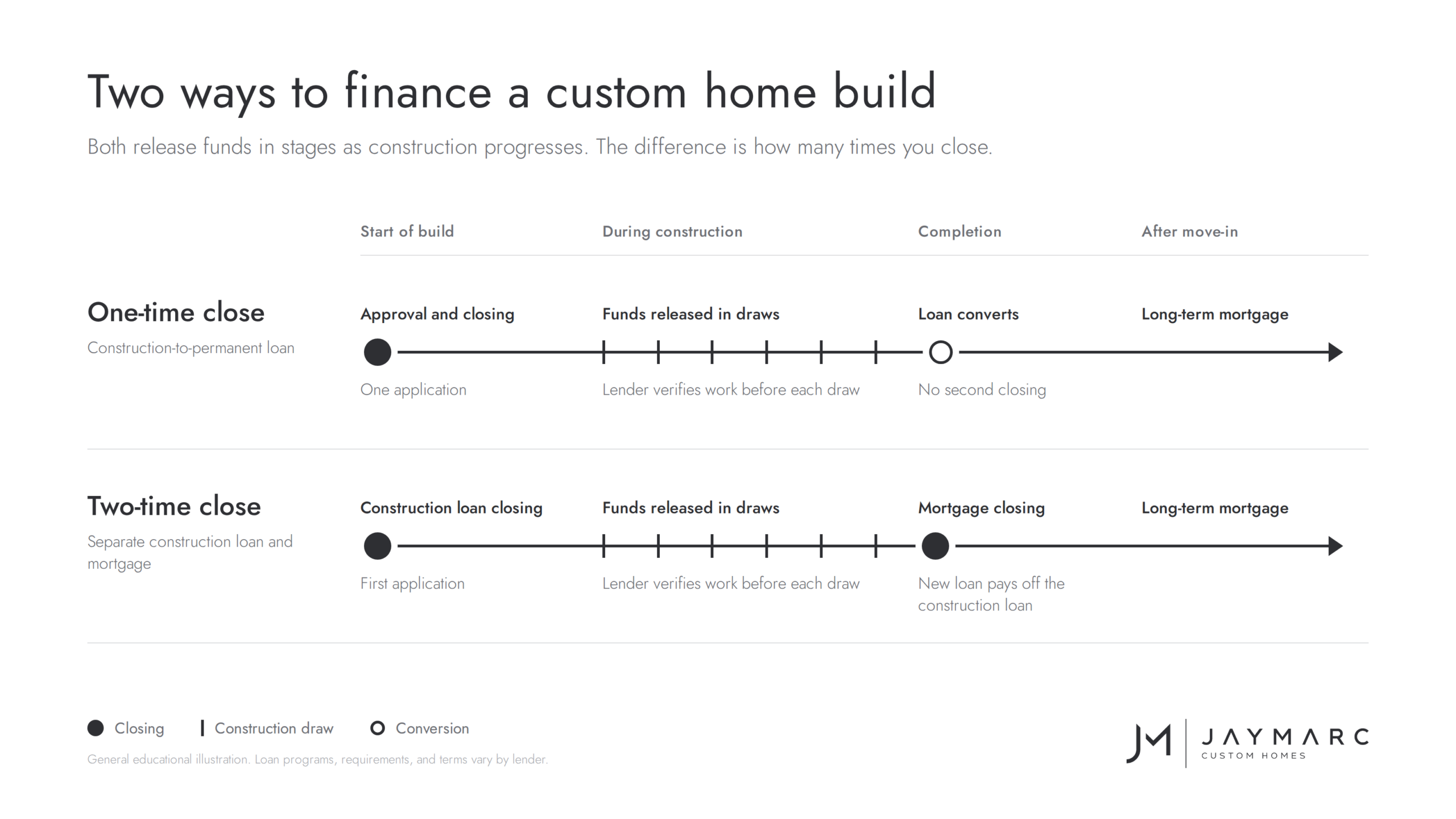
A construction loan provides funds for your home in stages, often called draws, as construction reaches certain milestones. Before releasing each draw, the lender typically verifies the completed work, often through an inspection.
During construction, many construction loans require interest payments only on the amount drawn so far, rather than the full loan amount. When the home is complete, the construction loan either converts to a long-term mortgage or is paid off with a new one.

One-Time Close vs. Two-Time Close
There are two common ways to structure construction financing:
- Construction-to-permanent (one-time close): A single loan covers construction and then converts to a long-term mortgage when the home is complete. You go through one approval and one closing.
- Two-time close: You take out a construction loan first, then apply for a separate mortgage when the home is finished. This means two closings, but it may give you more flexibility to compare mortgage options at the end of construction.
Each approach has trade-offs in cost, flexibility, and convenience. A construction lender can help you compare them based on your situation.
Down Payments, Land Equity, and Cash Reserves
Construction loans generally require a larger down payment than many standard home purchases, and requirements can be higher for larger loan amounts. Exact requirements vary by lender, loan program, and borrower.
If you already own your land, its equity can often count toward your down payment. This is one reason some buyers purchase a lot first and then finance construction separately.
Lenders also commonly look at your cash reserves, meaning the funds you’ll have available after closing. Because building a custom home involves more variables than buying an existing home, strong reserves can help your application and give you a cushion for decisions made during construction.
Jumbo Financing in the Greater Seattle Area
Many custom homes in the Greater Seattle area are financed with jumbo loans. A jumbo loan is a mortgage that exceeds the conforming loan limit the Federal Housing Finance Agency sets each year. King County is designated a high-cost area, so its limit is higher than in much of the country, but many Eastside custom home projects still exceed it.
Jumbo loans often come with stricter requirements for credit, income documentation, down payment, and reserves. Programs and terms also vary more from lender to lender, so it’s worth comparing options from lenders experienced with both jumbo and construction financing.
Managing Interest Rate Risk During a Longer Build
Because custom homes take time to design and build, interest rates may change between the start of your project and the day you move in. Buyers commonly manage this uncertainty in several ways.
Rate locks: Some construction-to-permanent programs allow you to lock your long-term rate early, while others set the rate when construction is complete. Some lenders offer extended rate locks or float-down options, which typically involve added costs. Ask each lender to explain how and when your rate is set, and what any lock option costs.
Fixed-rate vs. adjustable-rate mortgages: A fixed-rate mortgage keeps the same interest rate for the life of the loan. An adjustable-rate mortgage (ARM) has a fixed rate for an initial period and then adjusts periodically based on a market index, within limits set in the loan terms. The right choice depends on how long you plan to keep the loan and how comfortable you are with potential rate changes.
Future flexibility: Some homeowners later refinance if market conditions change, or make a large principal payment and ask their lender to recast the loan, which lowers the monthly payment while keeping the same rate and term. Neither option is guaranteed. Refinancing depends on future rates, your finances, and your home’s value, and not every loan allows recasting. These options are still worth understanding as part of your long-term plan.
Using RSUs, Stock, and Your Current Home
Many custom home buyers in Greater Seattle have significant assets outside of traditional savings, including equity compensation and equity in their current home. These can play an important role in financing.
RSUs and company stock: Some buyers sell vested shares to fund a down payment or construction costs. Others borrow against an investment portfolio rather than selling. Lenders may also count equity compensation as income when you qualify, though they usually require documentation showing a history of vesting and a reasonable expectation it will continue. Selling or borrowing against stock can have tax and investment implications, so it’s wise to talk with a tax advisor and financial advisor before deciding.
Your current home: You don’t necessarily need to sell your current home before you build. Many families stay in their current home during construction to avoid moving twice. Depending on your situation, options might include using savings, borrowing against your current home’s equity, using a bridge loan, or keeping your current home as a rental. Your lender will consider your existing mortgage when determining what you qualify for.
Questions to Ask a Construction Lender
Not every lender offers construction financing, and programs vary widely. When comparing lenders, consider asking:
- Do you offer one-time close, two-time close, or both?
- What are your down payment, credit, and reserve requirements for construction and jumbo loans?
- How and when is the interest rate set, and what lock options are available?
- How does the draw process work, and how long does each draw typically take?
- What do you need from my builder before approving the loan?
- How do you handle changes to the plans or budget during construction?
- How do you treat RSUs, bonuses, or other variable income?
- What fees should I expect during construction and at conversion or closing?
How Financing Fits Into Your Overall Project Budget
Your financing plan should reflect the full cost of your project, not just the construction contract. A complete custom home budget may include:
- Land purchase
- Feasibility studies, surveys, and engineering
- Architectural and interior design
- Permits and impact fees
- Site preparation and utilities
- Construction
- A contingency for unexpected conditions or changes
Site conditions can significantly affect cost. Steep slopes, utility extensions, drainage requirements, and critical areas can all add to your budget. That’s why evaluating your lot early, through a custom home feasibility study, helps you and your lender plan with more confidence.
Building With Confidence
Financing a custom home can feel complex at first, but you don’t have to figure it out alone. Talking with an experienced construction lender early, understanding your options, and building a realistic budget together give you a strong foundation for the rest of your project.
At JayMarc Custom Homes, we help clients align their design goals with a realistic project budget and provide the plans, budgets, and documentation lenders need for approval. When you’re ready to start planning, contact our team!
Start Your JourneyThis article is for general educational purposes only and does not constitute financial, tax, or legal advice. Loan programs, eligibility requirements, and terms vary by lender and may change. JayMarc Custom Homes is not a mortgage lender. Please consult a licensed mortgage professional and tax advisor about your specific situation.
Frequently Asked Questions About Financing a Custom Home
Most custom homes are financed with a construction loan, which pays for the build in stages as work is completed rather than all at once. When the home is finished, the construction loan converts to, or is replaced by, a long-term mortgage. Many buyers also use cash, investments, or equity in land they already own to cover part of the cost. A construction lender can help you compare options based on your goals and finances.
Sometimes. Some construction loan programs can include the land purchase along with construction costs, especially when you’re ready to begin design soon after buying. Other buyers finance the land separately with a lot loan or cash, then use a construction loan for the build. Land loans often have different requirements than construction loans or mortgages. If you already own your land, its equity may count toward your construction loan down payment.
Yes. Speaking with a construction lender early helps you understand your realistic budget before you invest time and money in design. Construction financing involves more steps than a standard mortgage, and the lender will review your plans, budget, and finances. Knowing what you can comfortably finance helps your design team create a home that fits both your goals and your budget from the start.
Lenders usually review the builder as well as the borrower. Common requirements include the construction contract, detailed plans and specifications, an itemized budget, a projected timeline, and proof of the builder’s licensing, registration, and insurance. The lender also orders an appraisal of the home as it will be when finished. An experienced builder can provide this documentation and coordinate with your lender throughout construction.
In most cases, you’ll need to cover the difference with your own funds. Construction lenders generally don’t increase the loan to cover overruns or upgrades added during the build. That’s why a realistic budget, thorough site evaluation, and a contingency for unexpected conditions are so important. Changes to plans or finishes during construction can also affect your budget, so it helps to finalize key decisions before construction begins.
Construction loans often carry somewhat higher rates than standard mortgages, because the lender is financing a home that hasn’t been built yet. Once construction is complete and the loan converts to, or is replaced by, a long-term mortgage, your rate is based on that mortgage’s terms. Rates, fees, and structures vary widely between lenders, so compare several options and ask how each lender sets the rate during each phase.
A mortgage recast lets you make a large lump-sum payment toward your principal and have your lender recalculate your monthly payment based on the new, lower balance. Your interest rate and loan term stay the same. Refinancing replaces your loan with a new one, usually with a new rate and term, an appraisal, and closing costs. Recasting typically involves a fee and a minimum payment amount, and not all loans are eligible.